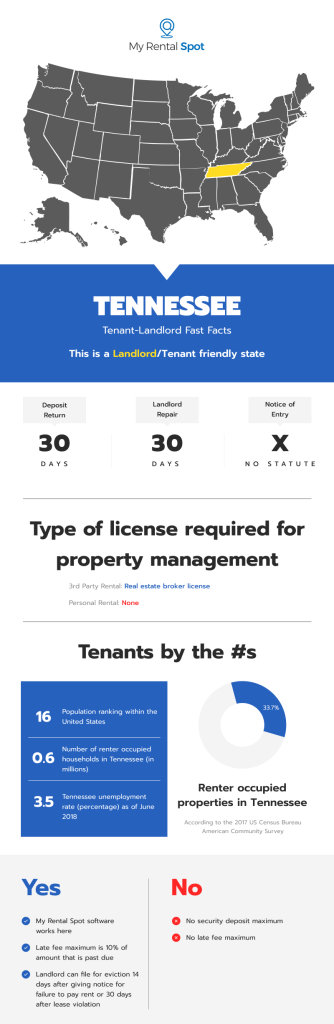
Entry NoticeNo statute, but 24 hours is recommended.Full text below ↓
Landlords and tenants will face legal issues during the rental process, but not every issue needs to involve the courts. This article will help you learn how the laws in your state handle everything from security deposits to termination notices so you can easily navigate these.
This article is not an exhaustive or a substitute for qualified legal advice. Laws and statutes are subject to change and may vary by county or city. You are responsible for performing your research and complying with all laws applicable to your unique situation.
If you have legal questions or concerns, we recommend consulting with the appropriate government agencies and a qualified lawyer. Your state bar association may have a referral service to help you find a lawyer with experience in landlord-tenant law.
Separate Security Deposit Bank Account: Required. The deposit must be kept in a bank or financial institution subject to state and federal regulations. (Tenn. Code Ann. § 66-28-301(a))
Record Keeping of Deposit Withholdings: No Statute
Receipt of Deposit: No Statute
Failure to Comply: No Statute
Lease, Rent, and Fees:
Rent Is Due: Unless otherwise agreed, rent is due at the beginning of each month and can be prorated day-to-day. (Tenn. Code Ann. § 66-28-201(c))
Rent Increase Notice: No Statute
Rent Grace Period: Five days from the rent due date, excluding Sundays and legal holidays. (Tenn. Code Ann. § 66-28-201(d))
Late Fees: Landlords can charge a late fee for past due rent, beginning after the fifth day that rent is due. Late fees cannot exceed 10% of the past-due rent. (Tenn. Code Ann. § 66-28-201(d))
Tenant Allowed to Withhold Rent for Failure to Provide a Habitable Dwelling: Yes. The tenant must file a complaint with a building inspector or the county public health department. If the landlord has not made the necessary repairs within 30 days, the tenant can pay rent to the county clerk for safekeeping. (Tenn. Code Ann. § 68-111-104)
●enant Allowed to Withhold Rent for Failure to Provide Essential Services (Water, Heat, etc.): Yes (Tenn. Code Ann. § 66-28-502)
Entry Allowed with Notice for Showings: Yes. Within the final thirty (30) days of the termination of the rental agreement, the landlord only needs to provide 24-hour notice if showing the property. This must be specified in the lease. (Tenn. Code Ann. § 66-28-403(e)(5))
Notice of Date/Time of Move-Out Inspection: No Statute
Entry Allowed During Tenant’s Extended Absence: Yes. In the statute, “emergency” is defined as “a sudden, generally unexpected occurrence or set of circumstances demanding immediate action.” (Tenn. Code Ann. § 66-28-507)
Notice to Tenants for Pesticide Use: No Statute
Lockouts Allowed: No
Utility Shut-offs Allowed: If the written rental agreement requires the tenant to have utility services in the tenant’s name and the tenant fails to do so within three (3) days of occupying the rental unit, the landlord may have utility services terminated if the services are in the name of the landlord. (Tenn. Code Ann. § 66-28-521)
Notice of Vehicle Towing: A landlord may have a vehicle towed with ten days’ notice, under the following circumstances: (Tenn. Code Ann. § 66-28-519)
Flat Tire(s): The car has one or more tires that are flat or missing;
Dead: The vehicle is unable to operate under its power;
Broken Glass: The car’s windshield is missing or damaged, or if there is one more window that is damaged or missing;
Missing Fenders: If one or more of the car’s fenders or bumpers are missing; Noncompliance: If the vehicle has not complied with any applicable local or state laws relative to titling, licensing, operation, and registration for more than thirty (30) days.
Notice of Extended Absence: If specified in the rental agreement, the tenant must notify the landlord of any absence of 7 days or longer. If the tenant fails to do so, the tenant can be held responsible for any damages resulting from their absence. (Tenn. Code Ann. § 66-28-404)
The tenant is absent from the premises for more than thirty (30) days or without explanation and has not paid the rent or
The tenant has not paid rent within fifteen (15) days past the due date, combined with other reasonable factual circumstances indicating the tenant has permanently vacated the premises.
10 Days: The tenant must contact the landlord within ten days of a notice to enter and take possession of the rental unit and express intent to continue renting the unit.
Relocation of Belongings: If the tenant fails to contact the landlord, personal property can be removed from the premises but must be stored for 30 days.
Sale or Dispose of: After 30 days, the landlord may sell or otherwise dispose of the tenant’s possessions and apply the sale proceeds to the unpaid rent, damages, storage fees, sale costs, and attorney’s fees.
Compliance: Comply with all obligations imposed by relevant building and housing codes that affect health and safety;
Cleanliness: Keep that part of the premises that the tenant occupies and uses as clean and safe as when the tenant began renting the unit;
Trash: Dispose of all garbage and other waste from the rental unit to designated collection areas and receptacles;
Lawful Activity: Tenants cannot engage in any illegal conduct on the premises, nor “deliberately or negligently” destroy, damage, or remove any part of the rental unit, or let anyone else do the same; and
Quiet Enjoyment: Act and require other persons on the premises, with the tenant’s or other occupant’s consent, to act in a manner that does not disturb the neighbors’ “peaceful enjoyment” of their premises.
Name and Addresses: Before a lease begins, the rental unit’s owner must disclose the name and address of the landlord, property owner, and anyone else authorized to manage the property or allowed to receive notice on the owner’s behalf. (Tenn. Code Ann. § 66-28-302)
Written Leases: A written lease is required for rental agreements that are for three years or longer. (Tenn. Code Ann. § 66-7-101)
Fair Housing:
Physically Disabled: Special rules apply to physically disabled persons’ access to housing. For details, see (Tenn. Code Ann. § 66-7-104 and § 66-7-110)
Blind persons: Special rules apply to leasing to blind persons. For details, see (Tenn. Code Ann. § 66-7-106)
Notification by Email: If the tenant provides an email address in the rental agreement, any notification required to be sent to the tenant may be sent by email unless other statutes specify otherwise. (Tenn. Code Ann. § 66-28-108)
House Rules and Regulations: A landlord has the right to create rules and regulations at any time, under certain circumstances. The rule can be enforced against the tenant if “reasonable notice” is given of the rule’s creation is given, and it does not substantially change any part of the rental agreement. For more details, see(Tenn. Code Ann. § 66-28-402)
Domestic Violence Situations: No Statute
Retaliation: A landlord must not terminate, refuse to renew a lease, or fine a tenant for complaining to the landlord regarding the security deposit, making complaints to a government agency, or exercising any legal rights. (Tenn. Code Ann. § 66-28-514)
Lead Disclosure: Landlords must disclose all known lead paint hazards. Landlords must also provide tenants with an information pamphlet on lead-based paint hazards as an attachment to a written lease.
Business License: Each landlord of one or more dwelling units, in a county with a population over five hundred thousand (500,000) people, is required to disclose the following information to the local government responsible for enforcing building codes: (Tenn. Code Ann. § 66-28-107)
The landlord’s name, address and telephone number or the name, address and telephone number of the landlord’s agent; and
The street address and unit number for each dwelling unit that the landlord owns, leases, or subleases or has the right to own, lease, or sublease.
Landlords and tenants will face legal issues during the rental process, but not every issue needs to involve the courts. This article will help you learn how the laws in your state handle everything from security deposits to termination notices so you can navigate these with ease.
This article is not intended to be exhaustive or a substitute for qualified legal advice. Laws and statutes are always subject to change and may vary by county or city. You are responsible for performing your own research and complying with all laws applicable to your unique situation.
If you have legal questions or concerns, we recommend consulting with the appropriate government agencies and a qualified lawyer in your area. Your state bar association may have a referral service that can help you find a lawyer with experience in landlord-tenant law.
Separate Security Deposit Bank Account: Required. The deposit must be kept in a bank or financial institution subject to state and federal regulations. (Tenn. Code Ann. § 66-28-301(a))
Record Keeping of Deposit Withholdings: No Statute
Receipt of Deposit: No Statute
Failure to Comply: No Statute
Lease, Rent, and Fees:
Rent Is Due: Unless otherwise agreed, rent is due at the beginning of each month and can be prorated day-to-day. (Tenn. Code Ann. § 66-28-201(c))
Rent Increase Notice: No Statute
Rent Grace Period: Five days from the day the rent is due, excluding Sundays and legal holidays. (Tenn. Code Ann. § 66-28-201(d))
Late Fees: Landlords can charge a late fee for past due rent, beginning after the fifth day that rent is due. Late fees cannot exceed 10% of the past due rent. (Tenn. Code Ann. § 66-28-201(d))
Tenant Allowed to Withhold Rent for Failure to Provide a Habitable Dwelling: Yes. The tenant must file a complaint with a building inspector or with the county public health department. If the landlord has not made the necessary repairs within 30 days, the tenant is allowed to pay rent to the county clerk for safe keeping. (Tenn. Code Ann. § 68-111-104)
●enant Allowed to Withhold Rent for Failure to Provide Essential Services (Water, Heat, etc.): Yes (Tenn. Code Ann. § 66-28-502)
Entry Allowed with Notice for Showings: Yes. Within the final thirty (30) days of the termination of the rental agreement, the landlord only needs to provide 24 hours notice if showing the property. This must be specified in the lease. (Tenn. Code Ann. § 66-28-403(e)(5))
Notice of Date/Time of Move-Out Inspection: No Statute
Entry Allowed During Tenant’s Extended Absence: Yes. In the statute, “emergency” is defined as “a sudden, generally unexpected occurrence or set of circumstances demanding immediate action.” (Tenn. Code Ann. § 66-28-507)
Notice to Tenants for Pesticide Use: No Statute
Lockouts Allowed: No
Utility Shut-offs Allowed: If the written rental agreement requires the tenant to have utility services in the tenant’s name and the tenant fails to do so within three (3) days of occupying the rental unit, the landlord may have utility services terminated if the services are in the name of the landlord. (Tenn. Code Ann. § 66-28-521)
Notice of Vehicle Towing: A landlord may have a vehicle towed with 10 days notice, under the following circumstances: (Tenn. Code Ann. § 66-28-519)
Flat Tire(s): The car has one or more tires that are flat or missing;
Dead: The car is unable to operate under its own power;
Broken Glass: The car’s windshield is missing or broken, or if there are one more windows that are broken or missing;
Missing Fenders: If one or more of the car’s fenders or bumpers are missing; Noncompliance: If the car has not been in compliance with any applicable local or state laws relative to titling, licensing, operation, and registration for more than thirty (30) days.
Notice of Extended Absence: If specified in the rental agreement, the tenant must give notice to the landlord of any absence of 7 days or longer. If the tenant fails to do so, the tenant can be held responsible for any damages resulting from his/her absence. (Tenn. Code Ann. § 66-28-404)
The tenant is absent from the premises for more than thirty (30) days or more without explanation and has not paid the rent, or
The tenant has not paid rent within fifteen (15) days past the due date, combined with other reasonable factual circumstances indicating the tenant has permanently vacated the premises.
10 Days: The tenant must contact the landlord within 10 days of a notice to enter and take possession of the rental unit and express intent to continue renting the unit.
Relocation of Belongings: If tenant fails to contact the landlord, personal property can be removed from the premises but must be stored for not less than 30 days.
Sale or Dispose of: After 30 days, the landlord may sell or otherwise dispose of the tenant’s possessions and apply the proceeds of the sale to the unpaid rents, damages, storage fees, sale costs and attorney’s fees.
Compliance: Comply with all obligations imposed by relevant building and housing codes that affect health and safety;
Cleanliness: Keep that part of the premises that the tenant occupies and uses as clean and safe as when the tenant began renting the unit;
Trash: Dispose all garbage and other waste from the rental unit to designated collection areas and receptacles;
Lawful Activity: Tenants cannot engage in any illegal conduct on the premises, nor “deliberately or negligently” destroy, damage or remove any part of the rental unit, or let anyone else do the same; and
Quiet Enjoyment: Act and require other persons on the premises, with the tenant’s or other occupants’ consent, to act in a manner that does not disturb the neighbors’ “peaceful enjoyment” of their premise.
Name and Addresses: Before a lease begins, the rental unit’s owner must disclose the name and address of the landlord, property owner, and anyone else authorized to manage the property or allowed to receive notice on the owner’s behalf. (Tenn. Code Ann. § 66-28-302)
Written Leases: A written lease is required for rental agreements that are for three years or longer. (Tenn. Code Ann. § 66-7-101)
Fair Housing:
Physically Disabled: Special rules apply to physically disabled persons’ access to housing. For details, see (Tenn. Code Ann. § 66-7-104 and § 66-7-110)
Blind persons: Special rules apply to leasing to blind persons. For details, see (Tenn. Code Ann. § 66-7-106)
Notification by Email: If the tenant provides an email address in the rental agreement, any notification required to be sent to the tenant may be sent by email unless other statutes specify otherwise. (Tenn. Code Ann. § 66-28-108)
House Rules and Regulations: A landlord has the right to create rules and regulations at any time, under certain circumstances. The rule can be enforced against the tenant if “reasonable notice” is given of the rule’s creation is given, and it does not substantially change any part of the rental agreement. For more details, see(Tenn. Code Ann. § 66-28-402)
Domestic Violence Situations: No Statute
Retaliation: A landlord must not terminate, refuse to renew a lease, or fine a tenant for complaining to the landlord regarding the security deposit, making complaints to a government agency, or exercising any legal rights. (Tenn. Code Ann. § 66-28-514)
Lead Disclosure: Landlords must disclose all known lead paint hazards. Landlords must also provide tenants with an information pamphlet on lead-based paint hazards as an attachment to a written lease.
Business License: Each landlord of one or more dwelling units, in a county with a population over five hundred thousand (500,000) people, is required to disclose the following information to the local government responsible for enforcing building codes: (Tenn. Code Ann. § 66-28-107)
The landlord’s name, address and telephone number or the name, address and telephone number of the landlord’s agent; and
The street address and unit number for each dwelling unit that the landlord owns, leases, or subleases or has the right to own, lease, or sublease.
This guide is not legal advice. Laws change and may vary by county or city — verify
against the linked official statutes and consult a qualified lawyer for your situation.